 Image 1 of 1
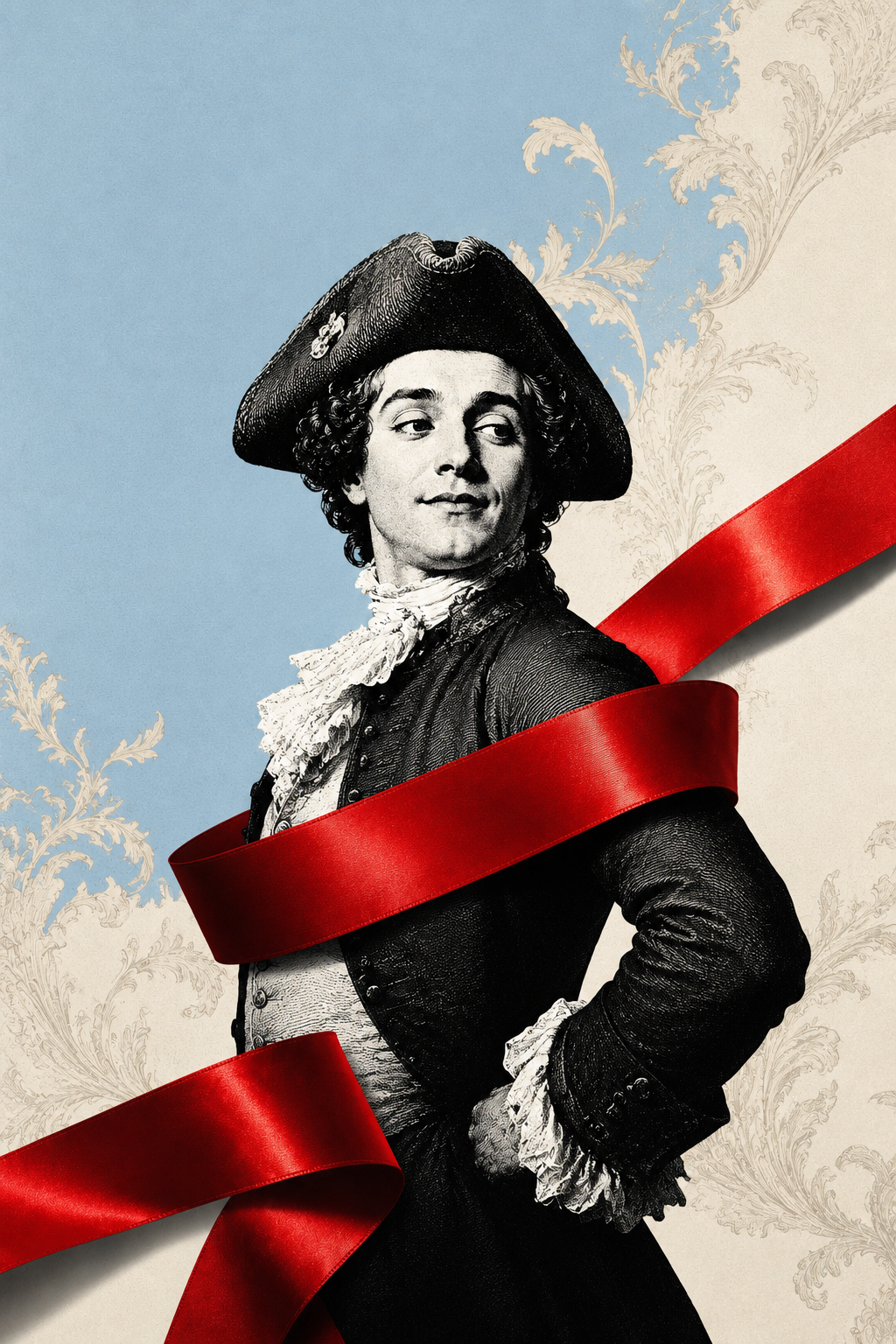
PIERRE-AUGUSTIN CARON DE BEAUMARCHAIS (1732–1799) was a watchmaker’s son who became, in turn, music master to the daughters of Louis XV, a global financier, a secret agent, and the man who quietly armed the American Revolution—supplying Washington’s troops with thousands of muskets. Le Mariage de Figaro, written around 1778, was so subversive it was banned by Louis XVI, who famously declared that “this man mocks everything that must be respected in a government.” For three years, the play lived in secret: private salons read it aloud to packed rooms while even Marie-Antoinette pleaded for its public performance. When it finally premiered in 1784, applause constantly interrupted it, and Napoleon would later call it “the Revolution already in action.”
The plot recalls the mechanics of classic farce: Count Almaviva seeks to seduce Suzanne, the bride of his valet Figaro, by claiming an archaic feudal right. But under the comedic surface of door-slamming and mistaken identities lies a dangerous claim: that intelligence, not birth, is the true measure of a man. As the servants scheme and the aristocrats stumble, every mask eventually falls. The play’s most explosive moment comes during Figaro’s celebrated monologue, where he addresses the Count with a line that shattered the Old World: “Vous vous êtes donné la peine de naître, et rien de plus” (“You took the trouble to be born, and nothing more”).
Reading theater aloud is perhaps the most effective way to master French prosody and phonetics, and Beaumarchais’s dialogue—precise, rhythmic, and sharp—is the ideal training ground. His language is as political as it is beautiful: every joke aims at a hierarchy, and every reply lands like a swordstroke. Two years after the premiere, Mozart and Da Ponte adapted it into their legendary opera, but the original play remains faster, more subversive, and ruthlessly hilarious. We will follow Figaro’s own pace: rapid, mischievous, and historically irreversible.