 Image 1 of 1
“- Comment ça va, Janet ?
- Mal et ça dure.
- Tu souffres ?
- De la tête.
- La tête te fait mal ?
- Non. Elle ne fait pas mal comme aux autres ; elle est pleine, voilà, et elle craque toute seule dans l’ombre, comme un vieux bassin. On me laisse seul tout le temps, je peux pas parler, ça s’accumule dans moi, ça pèse sur les os. Il en coule bien un peu par les yeux, mais les gros morceaux, ça peut pas passer, ils restent dans la tête.
- Les gros morceaux de quoi ?
- De vie, Jaume.”
Jean Giono (1895–1970) spent nearly his entire life in Manosque, a small Provençal town cradled at the foot of the Alps, and drew from its landscapes, its speech, and its light a body of work unlike any other in twentieth-century French literature. The son of a cobbler of Piedmontese descent and a laundry woman, he left school at sixteen to work at a bank and educated himself by reading Homer, Virgil, and the Greek tragedians. The First World War, which he survived as an infantry soldier, left him with a lasting horror of violence and a conviction that the earth mattered more than the nations fighting over it. Colline, published in 1929 by Grasset, was his first novel. It won the Prix Brentano, was praised by André Gide, and opens the Trilogie de Pan, followed by Un de Baumugnes (1929) and Regain (1930), three novels in which the villages of upper Provence become the theater of forces that are at once geological, mythological, and human.
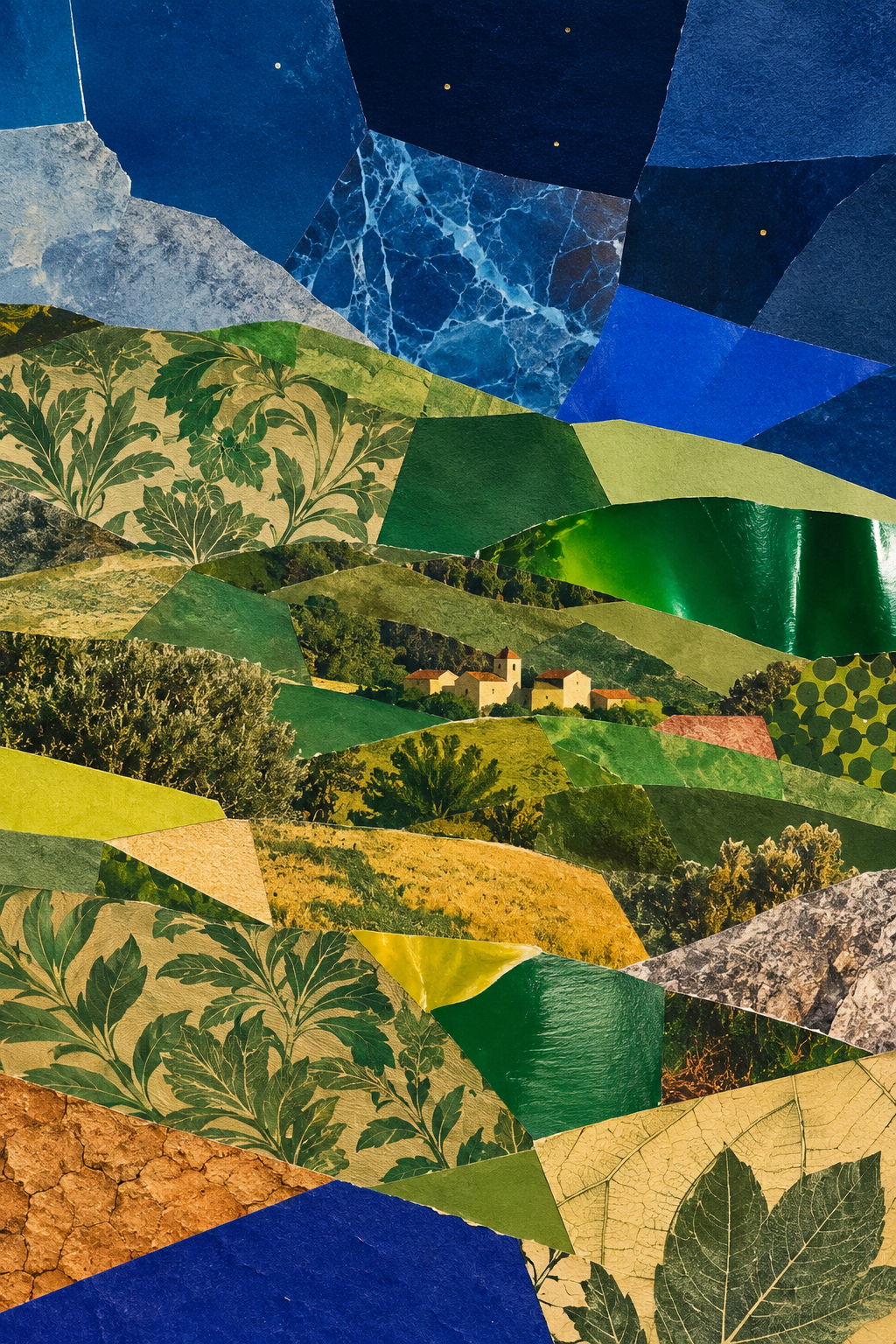
The setting is a place called Les Bastides Blanches, a hamlet so small it barely warrants a name. Four houses, twelve inhabitants, a village square of packed earth, and a single fountain stand at the edge of the monts de Lure, between the lavender plains and the high dry slopes where the wind never stops. Life follows its slow routines: Jaume hunts, Gondran works his fields, Gagou the village simpleton wanders the paths. Then the eldest of the hamlet, old Janet, paralyzed and bedridden near the hearth, begins to speak. What he says is barely intelligible, but it flows without stopping, “comme un ruisseau,” and the things he seems to know about the land and its hidden forces unsettle everyone who hears him.
The fountain dries up; a child falls ill; a fire breaks out on the hillside. One by one the misfortunes accumulate, and the villagers, who had lived for years in uneasy companionship with the earth, begin to suspect that Janet, with his strange and unbroken monologue, has stirred something that should have been left alone. In “le pays du vent,” the restless Mistral carries strange thoughts, and, as fear overtakes reason, it stirs something no one can name. Giono weaves together the creak of a door, the smell of lavender in the heat, and the slow darkening of a collective conscience.
Giono’s language in Colline draws on the rhythms of rural Provençal speech, yet it is also exacting and steeped in the classical literature he taught himself as a young man in the back room of a bank. The result is a prose that feels both ancient and immediate, where nature acts as a character with its own will, its own anger, and its own dread—the same dread as a chorus in Sophocles. This is the vision that gives the Trilogie de Pan its name: a world still inhabited by the god of panic, where the hills remember what the people have forgotten. Nearly a century later, the questions Colline raises about humanity’s inherent propensity to assign blame and the profound interconnection between individuals and their surroundings have only become more pertinent.