 Image 1 of 1
GUY DE MAUPASSANT (1850–1893) entered literature as the pupil of Gustave Flaubert, who drew him into Émile Zola's naturalist circle. His story Boule de suif (1880) made his name overnight, and in barely a decade, he wrote some three hundred stories and six novels, becoming the towering French master of the short form—as sharp in social satire as he is unsettling in the fantastic tales gathered around Le Horla. He had also worked in the newsrooms he depicts in Bel-Ami (1885), and that firsthand knowledge gives the novel its edge.
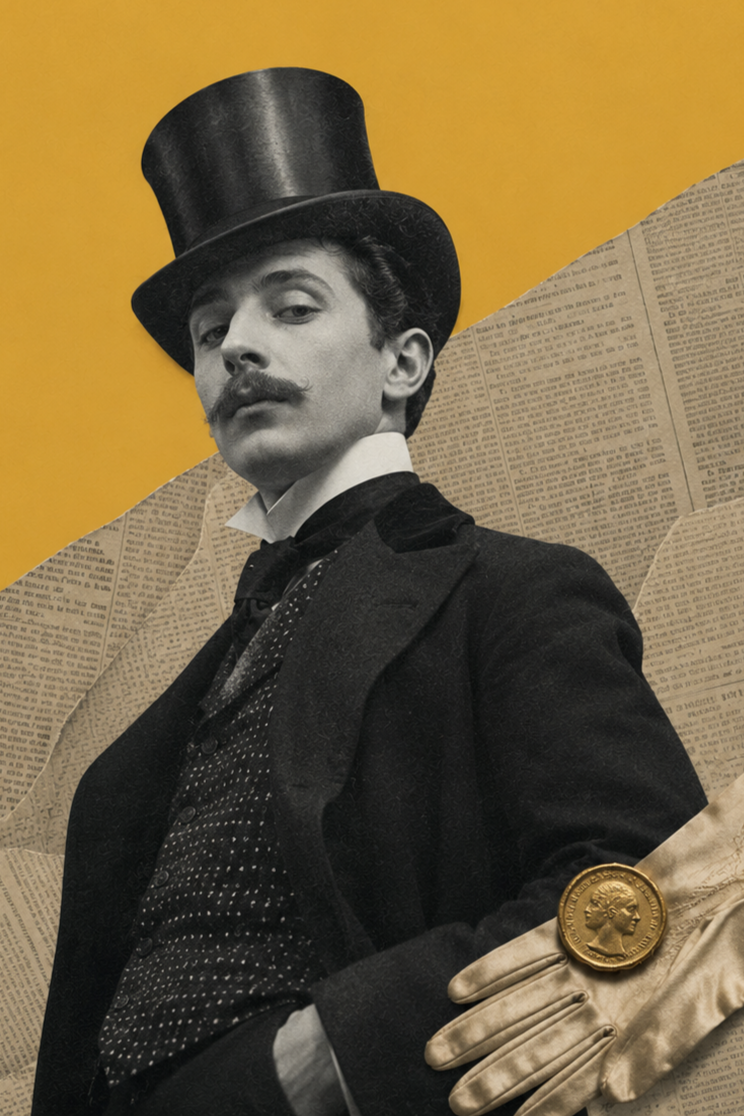
Georges Duroy steps onto a Paris boulevard with a few francs to his name, a discharged cavalryman back from Algeria, with no trade and no prospects. A chance meeting with an old regimental comrade sweeps him, that same night, from the crowd at the Folies-Bergère to a dinner where the city's editors and financiers talk business and into the cramped, ink-smelling offices of La Vie française, a newspaper whose real trade is not news. He cannot write; he learns quickly that this matters less than he feared. What he has is a face, a manner, and an instinct for pleasing, and it works on everyone, women most of all. His rise runs through a chain of them, each a rung higher than the last, drawing him ever closer to the summits of Parisian power. Yet Maupassant keeps us wondering: is Duroy a strategist orchestrating his rise or simply a cork floating on the currents of a world as cynical as he is?
Around this ascent, Maupassant paints the whole of Belle Époque Paris—from luxurious bourgeois drawing rooms to the dizzying cabarets and the smoky offices of a newsroom. But the picture turns bitter: a press that manufactures the very news it prints; colonial ventures run as financial speculation; and a society in which journalism, money, and politics have become one trade under three names. He keeps the writing swift and cinematic, close to what his hero notices: the price of a dinner, the cut of a dress, the sound of a coin turned in a pocket, the exact temperature of a room. The world he shows is sensory yet dispassionate, set down in the clinical, distant manner he learned from Flaubert: concise, concrete, and unadorned sentences; a detached, almost invisible narrator who leaves judgment to us. First published as a feuilleton, the novel breaks its chapters on hooks that still pull.
Duroy joins a lineage French literature keeps returning to: the arriviste—a social climber who elbows his way up. From the tragic ambitions of Stendhal's Julien Sorel to the relentless drive of Balzac's Eugène Rastignac—and later, Annie Ernaux's sharp accounts of social betrayal—the question underneath them never changes: were the promises of 1789 ever honored or only ever a bourgeois illusion? The book is full of unsparing irony, and beneath the glitter, a sense of mortality continues to surface until the social comedy takes on the weight of a memento mori. Even once the last page is turned, Duroy remains a mystery: is he a cynical parvenu or an unsparing mirror of what charm and a lack of scruples can buy? The character has never stopped fascinating: filmmakers have brought him to the screen again and again, and readers have argued about him since 1885 without reaching a verdict.