 Image 1 of 1
The trajectory of Andreï Makine (born 1957 in Siberia) is one of the most singular in contemporary French letters. Raised by his French-born grandmother, Charlotte, who taught him French as a “family dialect” in the depths of Soviet Russia, he arrived in Paris in 1987 and was eventually granted political asylum. His early years in France were a struggle for survival: he slept for a time in the Père-Lachaise cemetery and lived in tiny chambres de bonne while his manuscripts were repeatedly rejected. Publishers simply refused to believe a recent Russian exile could write such crystalline, sophisticated French; Makine eventually had to present his work as a “translation from the Russian” to be taken seriously. The ruse ended in 1995 when Le Testament français became the first book in history to win the Prix Goncourt, the Prix Médicis, and the Prix Goncourt des Lycéens in the same year.
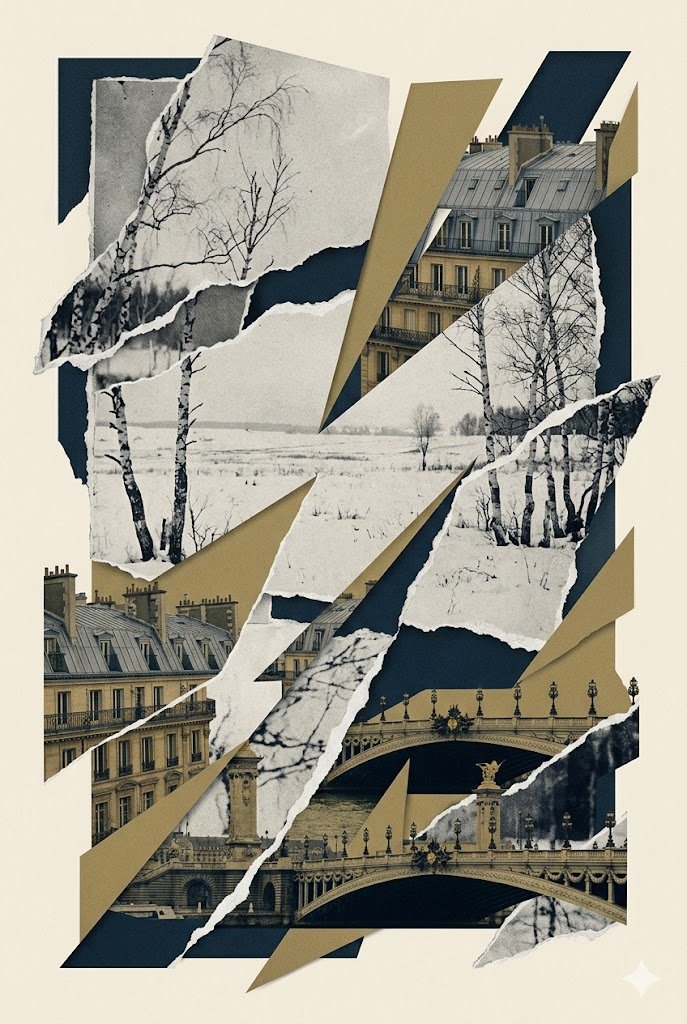
The novel is a luminous, autobiographical archaeology of memory. The narrator, young Aliocha, spends his summers in the steppe town of Saranza with his grandmother Charlotte. Stranded in Russia after the Revolution, Charlotte keeps her “Atlantis” (the France of her youth) alive through a battered suitcase of news clippings and photographs. Through her stories, the boy experiences a Belle Époque he has never seen: the visit of Tsar Nicolas II to Paris, the building of the Pont Alexandre III, and the great Seine flood of 1910. France becomes for him a mythical homeland to which he belongs more deeply than the Soviet reality surrounding him.
However, the discovery of a single photograph disrupts this idealized heritage. In it, Charlotte is unrecognizable—wrapped in a worker’s padded jacket and a man’s chapka, holding a swaddled baby against a harsh Siberian landscape. Why is she dressed like a woman clearing mountain roads when every other memory speaks of Parisian elegance? The novel is the slow, masterful unfolding of that photograph’s secret, tracing Charlotte’s survival through the tectonic shifts of the 20th century.
Makine’s prose is famously limpid, written with the precision and modesty of a writer who never takes a single word for granted. While his work shares with Proust a profound fascination for the way a single sensory detail can resurrect a lost world, Makine’s style remains remarkably accessible. He writes with the luminous perspective of an outsider who has fallen in love with a language, proving that a culture can be inherited and chosen even from a great distance. Le Testament français remains a haunting exploration of how language can become a refuge, a legacy, and ultimately, a destiny.